Catalogue of Making
Where Sounds Breathe
Main Page
Taxi exterior · entry scene
Materials
Films and stills from Main Page
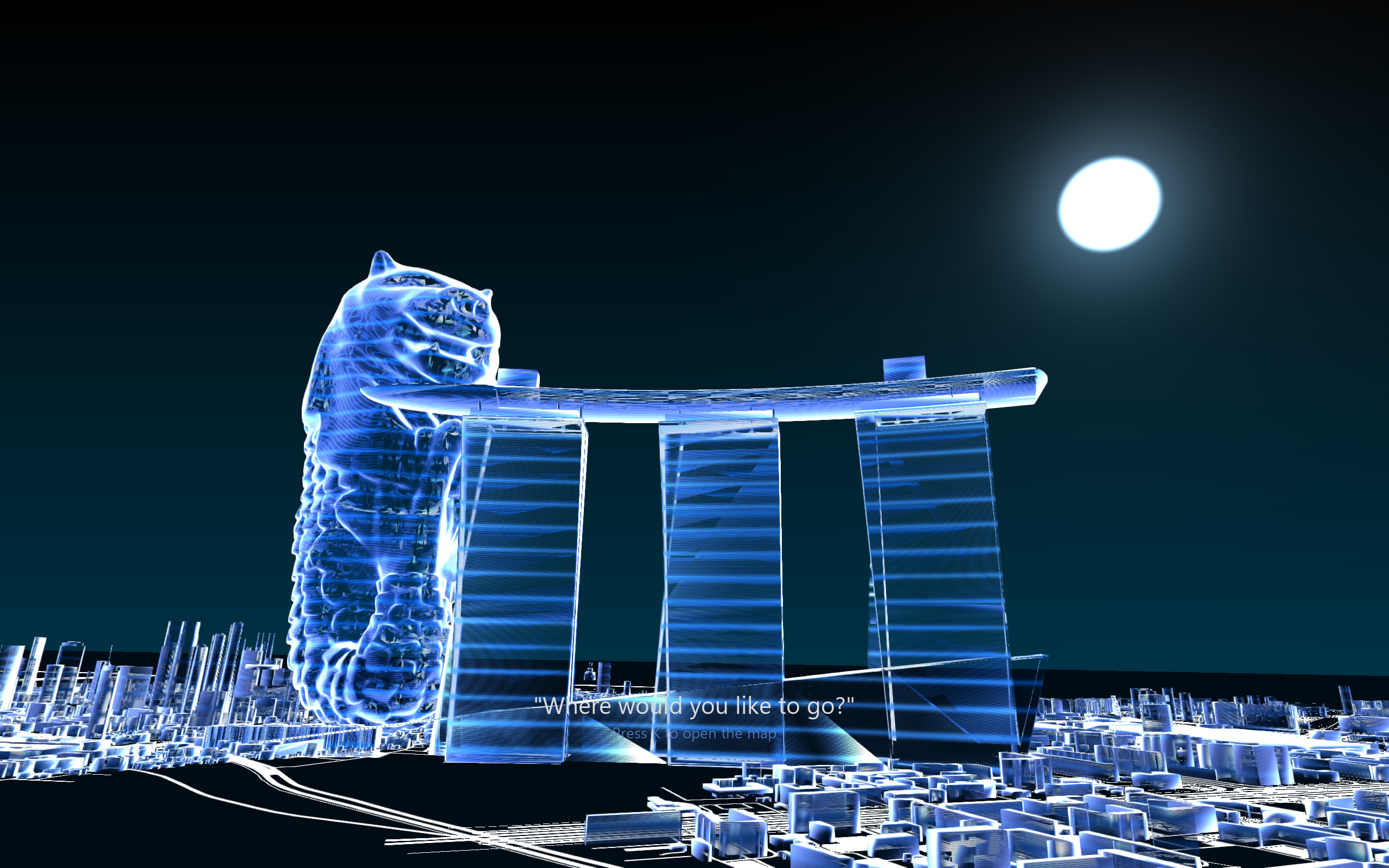
Marina Bay skyline
Main view of the Marina Bay area.
Technology Stack
Seven layers, human input to pixel out.
Stack diagram
View mode
Focus layer
Drag · orbit · Hover · highlight · Click · focus · Esc · exit
The project runs as a native desktop program, not a web app. Seven layers stack from human input down to the GPU and back to pixels. Mouse, keyboard, and webcam feed MediaPipe, which turns hand motion into twenty-one landmarks per frame. Python holds the main loop and decides what each frame should look like. ModernGL is a thin wrapper that speaks to OpenGL without getting in the way. OpenGL 4.3 runs compute shaders across SSBOs, which is where the particles actually live. The RTX 4070 Laptop GPU takes that work and paints the next frame sixty times a second. Each layer only talks to the one above and below it, so the stack stays simple to reason about.
Spatial Design
Interior as container. Exterior as bridge. Taxi as threshold.
Layer
Drag to orbit · scroll to zoom
Spatial grammar
Every interior is a container; the exterior is the bridge. The taxi is the threshold between. Its glass is an active surface, not mere cladding, that splits the experience into what approaches and what opens up. Bugis is built as layered glass because its cultures are transparent to each other. East Coast Park is built as a canopy because the district itself is a roof of leaves. Each interior follows its own spatial logic, but all share the same grammar of approach, threshold, and interior volume. Future districts will inherit the rule and break it where the district demands. The grammar is not a template but a starting point. Singapore has many skins. This project shows three of them and leaves space for more.
Bugis Interior
Glass architecture · religious coexistence
Materials
Films and stills from Bugis
Landscape overview
Full interior landscape of Bugis.
Sound
Field recordings and touch response from Bugis
- Buddhist temple
- Crosswalk beeps
- Bugis Junction interior
- Bugis Junction exterior
- Bugis+ interior
- Street ambience I
- Street ambience II
- Hawker centre
- Heji Lane jazz
- Hindu temple
- Pedestrian ambience
- Street walk
- Thong Hood Cho temple
Fluid Simulation
PIC/FLIP inside an axis-aligned bounding box.
PIC/FLIP · AABB
Particles: 50000
Force
View
PIC/FLIP is a hybrid. The Particle-in-Cell method interpolates velocities through a grid and smooths away noise; the Fluid-Implicit-Particle method keeps velocity on the particles themselves and preserves motion. A single blend parameter, here a slider, chooses how much of each. David Li’s WebGL FLIP was the reference. Its clarity was too useful to rewrite from scratch. The extension specific to this project is an axis-aligned bounding box. Bugis needs a room that holds its water; containers need walls. Particles reflect at the six faces, and the grid sampler clamps at those same faces so the fluid behaves like it lives inside a building rather than an infinite plane. Quiet audio lets the fluid settle. A strong beat lifts the whole volume at once.
East Coast Park Interior
Forest at dusk · bioluminescent
Materials
Films and stills from East Coast Park
Full landscape
Complete interior landscape of ECP.
Sound
Field recordings and touch response from East Coast Park
- Gravel run
- Distant horn
- Airplane landing
- Eagle call
- Breakwater waves
- Jungle at night
- Koel call
- Hand splash
- Otter peeps
- Seagulls
- Tropical birds
- Engine drone
- Wind storm
Audio System
FFT → bass / mids / treble → six visual forces.
Audio system
View
Audio enters as waveform, exits as force. An FFT splits each frame into three bands. Bass drives radial pulses, mids drive surface waves, treble drives ripple sparks. Recording is two-layered on purpose. An always-on ambient bed of the district plus a distinctive layer for foreground events. Zone-based mixing decides which recordings are audible according to where the visitor stands inside the world. One flag, “always-audible”, is reserved for the East Coast Park waves. The sea is part of ECP whether you are near it or not. Bugis keeps its prayer calls zoned, following the geography of the block, so coexistence is audible, not explained. The system runs on twenty-six recordings total, thirteen per district. Each was captured on site with a portable recorder and trimmed to loop without a seam.
Visual Languages
Three languages, one rule each. Bugis · glass. Main · hologram. ECP · bioluminescence.
§9.1 Prismatic Crown Glass
Prismatic crown glass
Drag to rotate · scroll to zoom
Why glass for Bugis. Four cultures transparent through each other. Chromatic dispersion mirrors audio frequency bands; the colour you see has been bent by the sound playing at that moment.
§9.2 Retro Rim-Light Hologram
Holographic skyline
Mouse side sets sweep direction
Hologram as medium for the invisible. Sound has no form. Holograms exist only as light. The language declares the rule.
§9.3 Bioluminescence
Bioluminescence
Mouse stirs (vortex)
Living light. Fireflies, deep sea, moss. The palette stays cool, intentionally opposite the Bugis warm glass.